


copyright 2026 All Rights ReservedGuangke (Shanghai) Industrial Automation Technology Co., Ltd. XML
Time:2026-10-12 Views:
1.Project background
Huayu is a domestic professional manufacturer of automotive thermal management parts. As production capacity expands and customers' requirements for quality traceability increase, the original production model relies on manual statistics and paper records. Production data is opaque, management decisions lag behind, and quality traceability efficiency is low. It cannot meet the supply chain audit requirements of vehicle customers. It urgently needs to achieve digital upgrade of production through the MES system.

2. Core pain points
1. Production data is collected and summarized manually, which results in lagging information and large errors, and the management cannot grasp the on-site production status in real time;
2. Quality traceability relies on paper records, and batches and processes cannot be quickly located when problems arise. Traceability costs are high and the cycle is long;
3. Extensive equipment management, post-failure repairs, uncontrollable downtime, and low overall equipment efficiency;
4. The production plan is disconnected from on-site execution, the progress of work orders is not transparent, and the order delivery cycle is difficult to accurately control.
3. Overall solution
Guangke Industrial customized the MES production management system to address customer production process and management pain points, covering five core modules: production planning, process execution, quality traceability, equipment management, and data analysis. The system is deeply connected with the customer's existing automated production lines to achieve automatic collection and real-time synchronization of production data, opening up a full-link data closed loop from planning to finished products, helping enterprises achieve transparent production, refined management, and digitalized decision-making.
4. Solution core configuration
1. Production planning and work order management: Realize the digitization of the entire process of production work order issuance, progress tracking, and process reporting. Work order progress is updated in real time, and order delivery status is clear at a glance;
2. Full-process quality traceability: material batches, assembly parameters, and inspection data are all bound and recorded, and the entire link of a single product is traceable. Quality problems can be located with one click to locate the cause and associated batches;
3. Intelligent equipment operation and maintenance management: Real-time collection of equipment operation data, integrated management of status monitoring, fault warning, and maintenance plans to reduce the risk of equipment downtime;
4. Multi-dimensional data analysis: Automatically generate multi-dimensional reports such as output, yield, cycle time, OEE, and personnel performance to provide data support for management decisions;
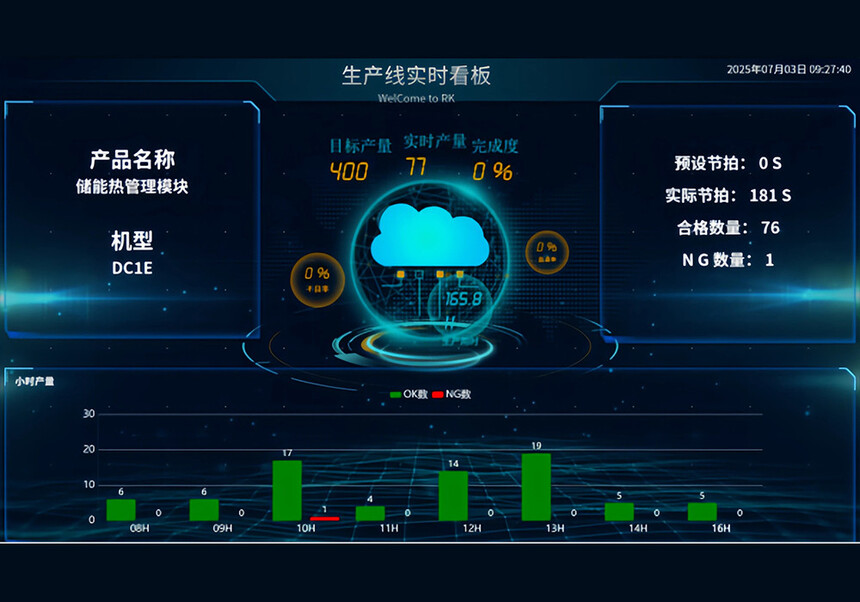
5. Production visualization linkage: supporting workshop visual signage, large-screen display of core production data, and real-time synchronization of on-site and management information;
6. System interface compatibility: Supports docking with customers’ existing ERP systems, opening up data links between upper-level enterprise management and on-site execution.
5. Project implementation results
1. The overall efficiency of equipment is increased by 15%: real-time monitoring of equipment status and fault warning, downtime is significantly reduced, and equipment OEE is steadily increased by more than 15%;
2. The efficiency of data statistics is increased by 80%: production data is automatically collected and summarized, eliminating the need for manual statistical reports, greatly reducing the statistical workload and making the data real-time and accurate;
3. Quality traceability efficiency increased by 90%: data from raw materials to finished products can be checked, and the time to locate quality problems is shortened from hours to minutes;
4. Improved order delivery accuracy: work order progress can be controlled in real time, production abnormalities can be responded to in a timely manner, and order delivery cycle accuracy has increased by 25%;
5. Optimization of management collaboration efficiency: production status is transparent, information of various departments is synchronized, and management decision-making efficiency is significantly improved.
6. Customer value and evaluation
After the implementation of this project, it helped customers completely get rid of the situation of production management relying on manual labor and data lag. Production management efficiency and quality control capabilities were greatly improved. It successfully passed the supply chain quality system audit of many vehicle customers, and also laid a solid foundation for the subsequent comprehensive digital upgrade of the factory.