


copyright 2026 All Rights ReservedGuangke (Shanghai) Industrial Automation Technology Co., Ltd. XML
Time:2026-10-13 Views:
1.Project background
This customer is a domestic professional plate heat exchanger manufacturing enterprise, and its products are widely used in the fields of automotive thermal management and energy storage temperature control. As orders grow, the original plate stacking process relies on manual operations, with low efficiency, unstable accuracy, and large yield fluctuations. It has become a production bottleneck, and there is an urgent need to upgrade automated stacking equipment.
2. Core pain points
1. Manual stacking efficiency is low, single-shift production capacity is limited, labor costs are high, and production capacity is insufficient during peak order seasons;
2. Stacking alignment accuracy depends on worker proficiency, product consistency is poor, and sealing performance yields fluctuate greatly;
3. There are many product specifications, manual changeover and adjustment are slow, and it is difficult to adapt to multi-variety and small-batch production;
4. Stacking quality relies on back-end detection feedback, which results in delayed problem discovery and high rework costs.
3. Overall solution
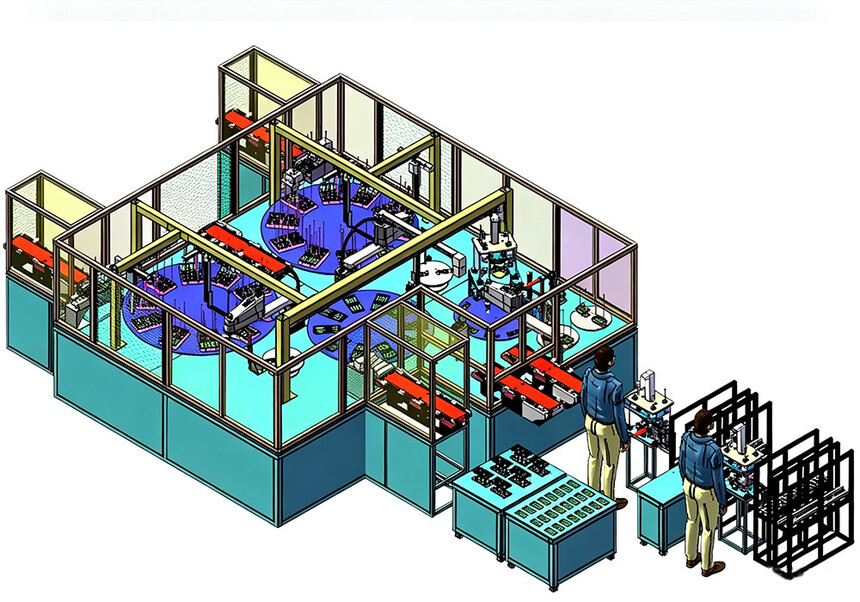
Based on the characteristics of customers' plate heat exchanger products, Guangke Industry has customized a fully automatic plate exchange and stacking assembly line. It uses visual positioning correction + precision mechanical limit technology to realize full-process automation of automatic plate material distribution, precise stacking, constant pressure compaction, and online inspection, effectively solving the accuracy and efficiency pain points of manual stacking.
4. Solution core configuration
1. Automatic plate sorting and loading: The plates are automatically sorted and loaded, the appearance and direction of the plates are visually detected, and unqualified pieces are automatically removed to ensure the quality of the incoming materials;
2. Visual positioning precision stacking: using visual positioning correction + precision positioning mechanism, precise stacking piece by piece, alignment accuracy ±0.1mm, high stacking consistency;
3. Servo constant pressure compression: The servo control system performs constant pressure compression, the compression force is monitored in real time, and the data is automatically recorded to ensure consistent assembly tightness;
4. Online sealing testing: After the stacking of finished products is completed, air tightness testing is performed simultaneously to instantly verify the sealing performance, and unqualified products are diverted in a timely manner to reduce rework costs;
5. Flexible adaptation to multiple specifications: Modular design supports rapid changeover of products with different sizes and layers of boards, adapting to multi-category production needs;
6. Data traceability management: Production data is automatically recorded, and the stacking parameters and test results of each product can be traced to facilitate quality control.
5. Project implementation results
1. Increase production efficiency by 50%: fully automatic stacking operations increase single-shift production capacity by 50%, reduce manual work stations, and significantly reduce labor costs;
2. Stable and controllable stacking accuracy: The stacking alignment accuracy is stable within ±0.1mm, product consistency is significantly improved, and the problem of manual accuracy fluctuations is completely solved;
3. The product yield rate is greatly improved: online inspection is performed in real time, the finished product sealing yield rate is increased to 99.2%, and the rework cost is greatly reduced;
4. The efficiency of model change is significantly improved: products of multiple specifications can be quickly changed, and the change time is shortened by 70%, adapting to the needs of multi-variety and small batch production.
6. Customer value and evaluation
After the stacking line was put into production, it successfully solved the production capacity and quality bottlenecks in the board replacement process, improved production efficiency and product quality, supported the rapid growth of customers' automotive and energy storage business orders, and accumulated mature experience for customers' subsequent comprehensive automation upgrades of production lines.